
Understanding Modularity in Software Architecture: A Comprehensive Guide
Breaking Down Complex Systems for Better Maintainability, Scalability, and Flexibility

In the world of software development, modularity is one of the most important concepts to understand. Imagine trying to build a large and complex machine without breaking it down into smaller, manageable parts. It would be extremely difficult, right? Software works the same way. Modularity is all about breaking down a large system into smaller, easier-to-understand components, or modules. In this article, we’ll explore what modularity is, why it’s important, and how you can measure it using several key metrics.
Let’s dive into the world of modularity in software architecture!
What is Modularity?
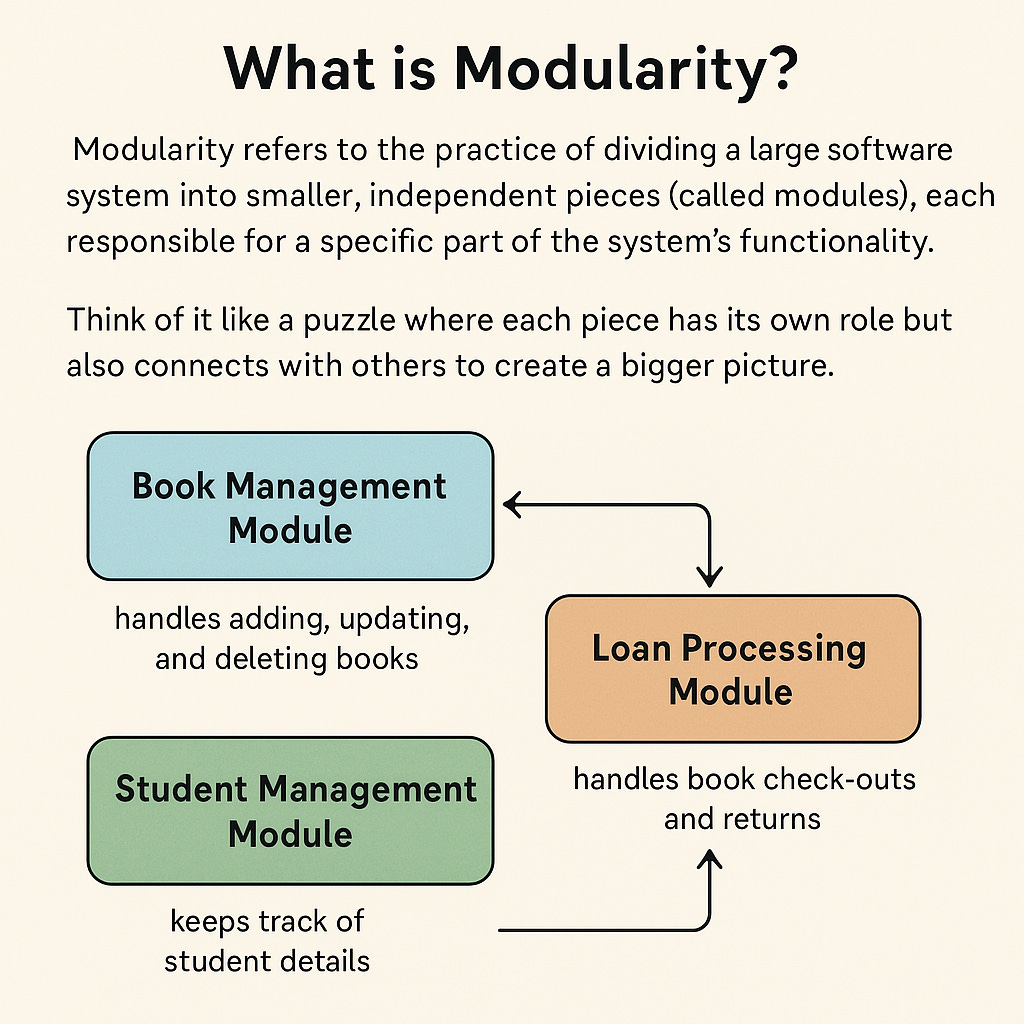
Modularity refers to the practice of dividing a large software system into smaller, independent pieces (called modules), each responsible for a specific part of the system's functionality. Think of it like a puzzle where each piece has its own role but also connects with others to create a bigger picture.
For example, imagine a software system that helps manage a school’s library. Instead of having one massive program that does everything—like tracking books, managing students, and processing loans—modularity breaks the system down into smaller, more manageable parts:
A Book Management Module handles adding, updating, and deleting books.
A Student Management Module keeps track of student details.
A Loan Processing Module handles book check-outs and returns.
By organizing the system this way, each part of the program can be developed, tested, and maintained independently, making the entire system easier to manage.
Why is Modularity Important?
The main reason modularity is so important is that it helps make software easier to:
Maintain: Smaller modules are easier to understand and modify, as you don’t need to worry about the whole system when making a change. For example, if you need to add a feature to the loan processing system, you only need to change that module, not the whole program.
Scale: If the system needs to grow in the future, you can simply add new modules or extend existing ones. It’s like adding more rooms to a house rather than building an entirely new house.
Test: Testing smaller parts of a system is easier than testing a massive system. By testing each module independently, you can ensure that everything works correctly before combining them.
Understand: Modularity makes it easier for new developers to understand how the system works because they can focus on one module at a time instead of trying to grasp everything all at once.
Key Concepts in Modularity
In order to understand modularity, we need to look at some important concepts that are closely related:
1. Coupling
Coupling measures how dependent one module is on another. When two modules are tightly coupled, they rely on each other heavily, which makes the system harder to change. The goal is to have low coupling, meaning modules are as independent as possible.
For example, imagine if the Loan Processing Module could only work if the Student Management Module was always running. If the student data is tightly linked to the loan data, then changing one part of the system could break the other. This is known as high coupling and is something we want to avoid.
Ideally, modules should interact with each other only through well-defined interfaces or APIs. If one module needs information from another, it should ask for it in a simple, straightforward way, with minimal reliance on the other module’s internal workings.
Here are different types of coupling:
Content Coupling (Worst Type)
When one module modifies or relies on the internal workings of another module.
Example: A function directly accesses variables inside another function.
Common Coupling
When multiple modules share the same global data.
Example: Two modules updating a global variable storing student records.
External Coupling
When modules depend on an external system or shared communication format.
Example: A module relying on a third-party API with a fixed data format.
Control Coupling
When one module controls the behavior of another by passing control information.
Example: A function passing a flag to another function to determine its execution path.
Stamp Coupling (Data Structure Coupling)
When one module passes a data structure (rather than just required data) to another module.
Example: A function passing an entire student object instead of just a student ID.
Data Coupling (Best Type)
When modules interact only by passing necessary data.
Example: A function passing a single book ID to another function to retrieve book details.
Aim for data coupling and avoid content/common coupling for a modular and maintainable system.
2. Cohesion
While coupling deals with how modules relate to each other, cohesion focuses on how related the elements within a single module are. High cohesion means that the tasks or operations within a module are closely related and work together toward a single goal.
For example, in our library system, the Book Management Module should only handle tasks related to books—like adding, removing, or updating books. If this module also handled student registrations, it would have low cohesion because it’s trying to do too many unrelated things.
High cohesion is important because it makes a module easier to maintain, test, and understand. If all the parts of a module work toward the same goal, it becomes more predictable and simpler to work with.
Here are different types of cohesion:
Coincidental Cohesion (Worst Type)
The module performs unrelated tasks grouped randomly.
Example: A module handling student data, book borrowing, and fee payments.
Logical Cohesion
The module performs related tasks, but the exact task is determined by an external control.
Example: A utility module with a single function that performs logging, validation, and data formatting based on a control parameter.
Temporal Cohesion
The module contains tasks that need to be executed at the same time.
Example: A startup module that initializes database connections and loads UI components together.
Procedural Cohesion
The module contains functions that execute in a specific order.
Example: A checkout module that processes a payment, generates an invoice, and sends an email confirmation sequentially.
Communicational Cohesion
The module contains functions that operate on the same data.
Example: A student module that retrieves, updates, and deletes student records.
Functional Cohesion (Best Type)
The module is responsible for one well-defined task.
Example: A book management module that handles all book-related operations like adding, deleting, and updating books.
Aim for functional cohesion and avoid coincidental/logical cohesion for maintainability and clarity.
3. Connascence
Think of connascence as a strong bond between two things—like two people who have to work together in a group project. If one person changes their part, the other also has to adjust their work to keep everything running smoothly.
In software, connascence means how much two parts of a program depend on each other. If they are highly dependent, changing one part forces you to change another. This can be a problem if not handled well.
There are two main types of connascence:
1. Static Connascence (Code-Level Rules)
This is when two parts of the program are linked at the code level, meaning they must follow certain rules to work correctly.
Example: Imagine you and your friend have a secret code for talking. If your friend changes the meaning of a word without telling you, you won’t understand them anymore.
🔹 Software Example:
A function expects a number, but someone changes it to expect text. The program might break because another function still expects a number.
Two modules must use the same variable names. If one module renames a variable, the other must also update it.
2. Dynamic Connascence (During Execution)
This is when two parts of the system depend on when and how things happen at runtime (when the program is running).
Example: Think of a relay race. If the first runner doesn’t pass the baton at the right moment, the next runner won’t know when to start.
🔹 Software Example:
If a program has steps that must happen in a certain order (like logging in before accessing user data), and someone changes this order, the system might fail.
A webpage loads certain data first. If the order changes, the page might show incorrect or missing information.
Why Does This Matter?
Too much connascence = Hard to change code.
Best practice: Reduce connascence, especially dynamic connascence, so changes don’t break the system.
Metrics for Measuring Modularity
Now that we’ve covered the main concepts related to modularity, let’s look at some metrics used to measure how well a system is modularized. These metrics help software architects understand whether the codebase is well-structured and if improvements are needed.
1. Afferent and Efferent Coupling
These metrics are used to measure the number of incoming and outgoing connections to a module, respectively.
Afferent Coupling: The number of modules that depend on a given module. High afferent coupling means that many other parts of the system rely on this module, so changes to it can have a large impact.
Efferent Coupling: The number of modules that a given module depends on. High efferent coupling means that the module relies heavily on others, making it difficult to modify or extend.
2. Abstractness
Abstractness measures the ratio of abstract components (like interfaces or abstract classes) to concrete components (like regular classes). A codebase with high abstractness might be hard to understand because there are too many abstractions without enough concrete examples.
Let’s say you’re designing a racing game.
Abstract Idea (Blueprint): Every car in the game has a speed, an engine, and can turn left or right.
Abstract Component (Interface or Abstract Class): A "Car" template that says, “Every car must have a speed, an engine, and be able to turn.” But it doesn’t create an actual car.
Concrete Component (Real Class): A "SportsCar" class that follows the Car template but has actual values (e.g., top speed = 300 km/h, red color, turbo boost).
What Happens If There's Too Much Abstractness?
If you only make templates (abstract classes) and never create actual cars, your game won’t have any playable vehicles! It will be too theoretical and hard to understand.
What Happens If There's Too Little Abstractness?
If you hardcode every car without a blueprint, you’ll have to rewrite everything from scratch for each new car. Your code will become rigid and difficult to update.
The Right Balance is Key
Use some abstraction (blueprints) to keep your code organized and flexible.
Use some concrete implementation (actual working cars) to make the system usable.
Too many abstractions can make it hard to understand how everything fits together, while too few abstractions can make the system rigid and difficult to maintain.
If designed well, abstract components act like blueprints, while concrete components build the actual structure.
3. Instability
When we talk about instability in software, we are trying to measure how likely a module (a part of a program) is to break when changes are made.
To understand this, let's break it down into two key ideas:
How many other modules this module depends on (Efferent Coupling).
How many modules depend on this module (Afferent Coupling).
Instability is calculated as:

This formula helps us see how dependent a module is on others.
High instability means the module depends on many other modules, making it vulnerable to changes.
Low instability means the module is relatively independent, making it more stable and easier to modify.
Example 1: A Weak Bridge (High Instability)
Imagine you have a weak wooden bridge that connects many different roads. Every time one of those roads changes (like adding more traffic or a new exit), the bridge needs to be rebuilt.
This bridge is like a module with high instability.
It depends on too many things, so even small changes can break it.
A software module with high instability relies on many other parts of the system. If any of those parts change, it might stop working properly.
Example 2: A Strong Independent House (Low Instability)
Now, imagine a house on a quiet street. It stands by itself and does not rely on other houses. If a nearby house is renovated or removed, it does not affect this house.
This is like a module with low instability.
It does not depend on many other things, so changes in the system do not break it.
A software module with low instability is more stable and easier to modify without breaking the entire system.
Why is Low Instability Important?
Easier to Maintain: If a module is independent, fixing or upgrading it does not cause issues elsewhere.
Fewer Bugs: Fewer dependencies mean fewer chances for errors when something changes.
Better System Design: Software with independent modules is more scalable and flexible.
4. Distance from the Main Sequence
The Distance from the Main Sequence (D) is a metric that helps assess how well a system balances abstractness and instability. It is particularly useful in software architecture to determine whether a module is well-structured or needs improvement.
The Main Sequence is an ideal line in a graph where a module is considered perfectly balanced between:
Abstractness (A) – How abstract a module is (i.e., how many interfaces/abstract classes it has).
Instability (I) – How unstable a module is (i.e., how dependent it is on other modules).
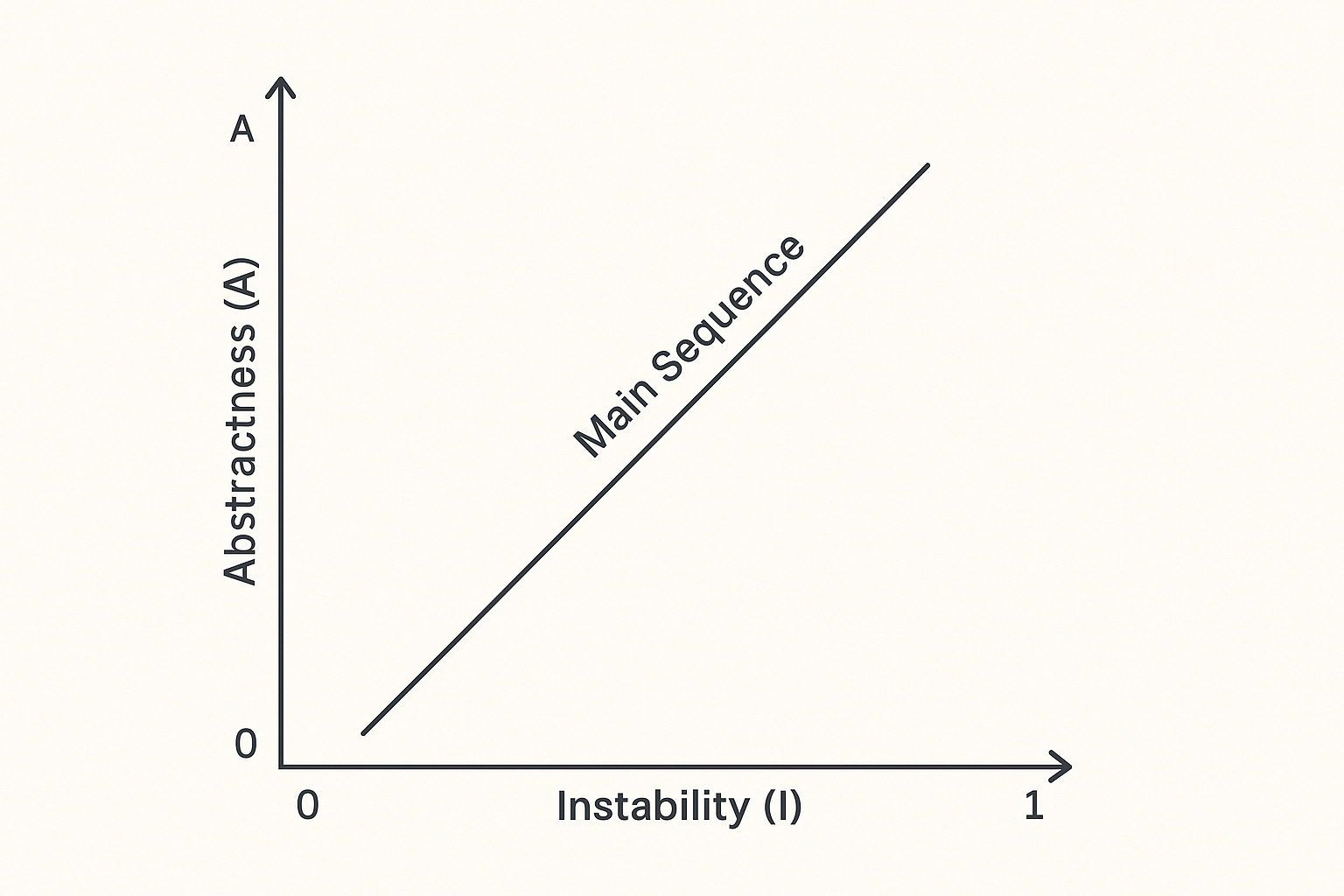
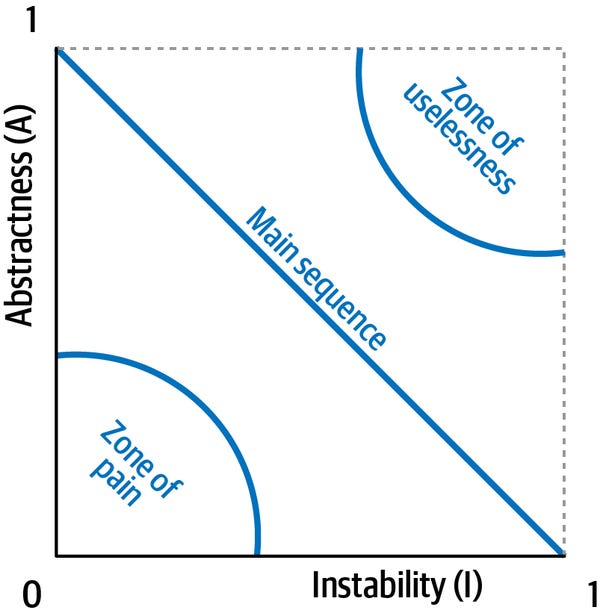
The main sequence runs diagonally from (0,1) to (1,0) in a graph where:
The X-axis represents instability (I).
The Y-axis represents abstractness (A).
Why is this Important?
By measuring Distance from the Main Sequence, software architects can:
Identify problematic modules that are either too rigid or too unstable.
Improve software design by balancing abstraction and coupling.
Make better refactoring decisions to enhance modularity.
Visualizing Modularity: Zones of Uselessness and Pain
A helpful way to understand how abstractness and instability relate is by graphing them. When you plot abstractness on the Y-axis and instability on the X-axis, you get a “main sequence,” which represents the ideal balance between these two factors.
1. Zone of Pain (Too Rigid, Hard to Modify)
Modules in this zone are too concrete, meaning they are very specific and lack flexibility.
They have low abstractness, making them difficult to update or improve.
If one part of the system changes, these modules may break or require major modifications.
Example:
Imagine a remote-controlled car where the battery, wheels, and motor are all glued together permanently. If the motor stops working, you cannot replace it without breaking everything.
In software, this happens when a program is designed too rigidly, making small changes very difficult and time-consuming.
2. Zone of Uselessness (Too Abstract, Hard to Use)
Modules in this zone are too abstract, meaning they are extremely flexible but lack clear functionality.
They have too much abstraction, making them confusing or impractical to use.
They may require a lot of extra steps to work, making development harder.
Example:
Imagine you receive a box of 100 different robot parts but no instructions on how to assemble them. The robot could be customized in many ways, but without clear guidance, it becomes too complex to use.
In software, this happens when a system is overly flexible, making it hard to understand and apply in real-world scenarios.
The Ideal Balance: The Main Sequence
A well-designed system stays close to the main sequence on the graph.
This means modules are abstract enough to be flexible but not so abstract that they are difficult to use.
They also have some level of stability but are not too rigid, so they can be modified when needed.
Conclusion
Modularity is a cornerstone of good software design. It helps us break complex systems into manageable parts, making them easier to maintain, scale, and understand. By focusing on low coupling, high cohesion, and minimizing connascence, developers can create software that is both flexible and stable.
Using metrics like afferent and efferent coupling, abstractness, instability, and distance from the main sequence, architects can assess the modularity of their systems and make improvements where necessary. Modularity doesn’t just make code easier to maintain—it also makes it easier to understand, test, and evolve as new requirements come up.
In short, modularity is about creating clean, understandable, and well-organized systems that can grow and adapt over time—just like how a puzzle is much easier to solve when each piece fits perfectly into its place.