
Understanding the Difference Between Architecture Style and Architecture Pattern
A Simple Guide to Understanding the Big Picture and the Smart Solutions Inside Software Design

When you're new to software design, it can be confusing to hear people talk about architecture styles and architecture patterns. They sound similar, but they mean different things.
Imagine you are the mayor of a brand new city. You have two big jobs:
Decide how your city is laid out.
Figure out how to make things inside the city work smoothly.
These two jobs are just like choosing an architecture style and architecture patterns in software.
What is an Architecture Style?
An architecture style is the overall structure of your software system. It's the big-picture layout. It decides how the parts of your system are organized, how they interact, and how data flows.
City Example
Let’s say you’re designing your city:
You can build one huge building where everything happens under one roof. That’s like a monolithic architecture.
Or you can build many smaller buildings, each one doing a specific job: one for shopping, one for education, one for healthcare. That’s like microservices architecture.
You might even create temporary pop-up buildings that appear only when needed and disappear later. That’s like serverless architecture.
Each of these city layouts represents a style — a way to organize your city.
In software, styles define the big structure:
Monolithic
Microservices
Layered (n-tier)
Serverless
Each style has pros and cons. Your choice depends on what kind of system you're building and what problems you're trying to solve.
What is an Architecture Pattern?
Once your city layout is done, you start designing how things work inside your buildings. These are the architecture patterns — reusable solutions to specific problems inside your software.
City Example
In your city:
What if the electricity fails in one building? You add backup generators. That’s like the Circuit Breaker pattern.
What if packages need to be delivered fast across the city? You design an automated delivery system. That’s like an Event-Driven pattern.
What if there’s always a line at the bank? You split the counter into two — one for deposits and one for withdrawals. That’s like the CQRS (Command Query Responsibility Segregation) pattern.
In software, patterns are design techniques that solve common problems:
Circuit Breaker – prevents system crashes when a service fails
Event-Driven – sends messages across systems when something happens
CQRS – separates read and write operations for better performance
These patterns help your system run more reliably, faster, and smarter.
Real Software Example: A Gaming App
Let’s say you're building a multiplayer gaming app.
Step 1: Choose an Architecture Style
You decide to use microservices architecture:
One service handles login
Another handles the game engine
Another handles chat
Now, your app is easier to manage, update, and scale.
Step 2: Use Architecture Patterns Inside
You use the Circuit Breaker pattern in the chat service. If it fails, the game keeps running.
You use the Event-Driven pattern to broadcast messages when someone scores or wins.
You’ve used a style to organize your system and patterns to solve specific problems within it.
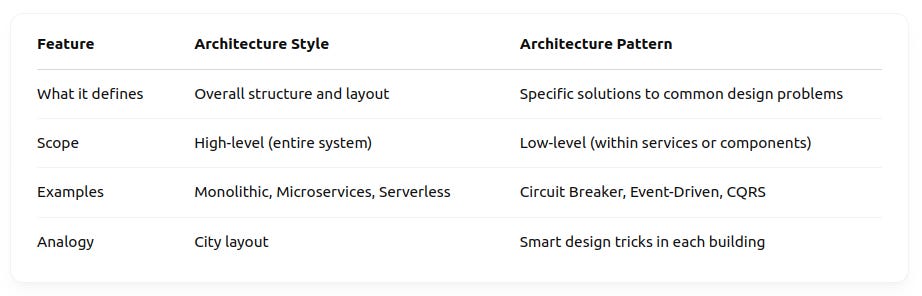
The Key Difference
Conclusion
To keep it simple:
Architecture Style is how your entire system is structured.
Architecture Pattern is how you solve specific problems inside that structure.
Just like a city needs both a well-thought layout and smart buildings, good software needs both architecture styles and architecture patterns. Understanding this difference helps you build software that is not just functional, but also efficient and reliable.